Monday – January 26, 2026 – Puntarenas, Costa Rica
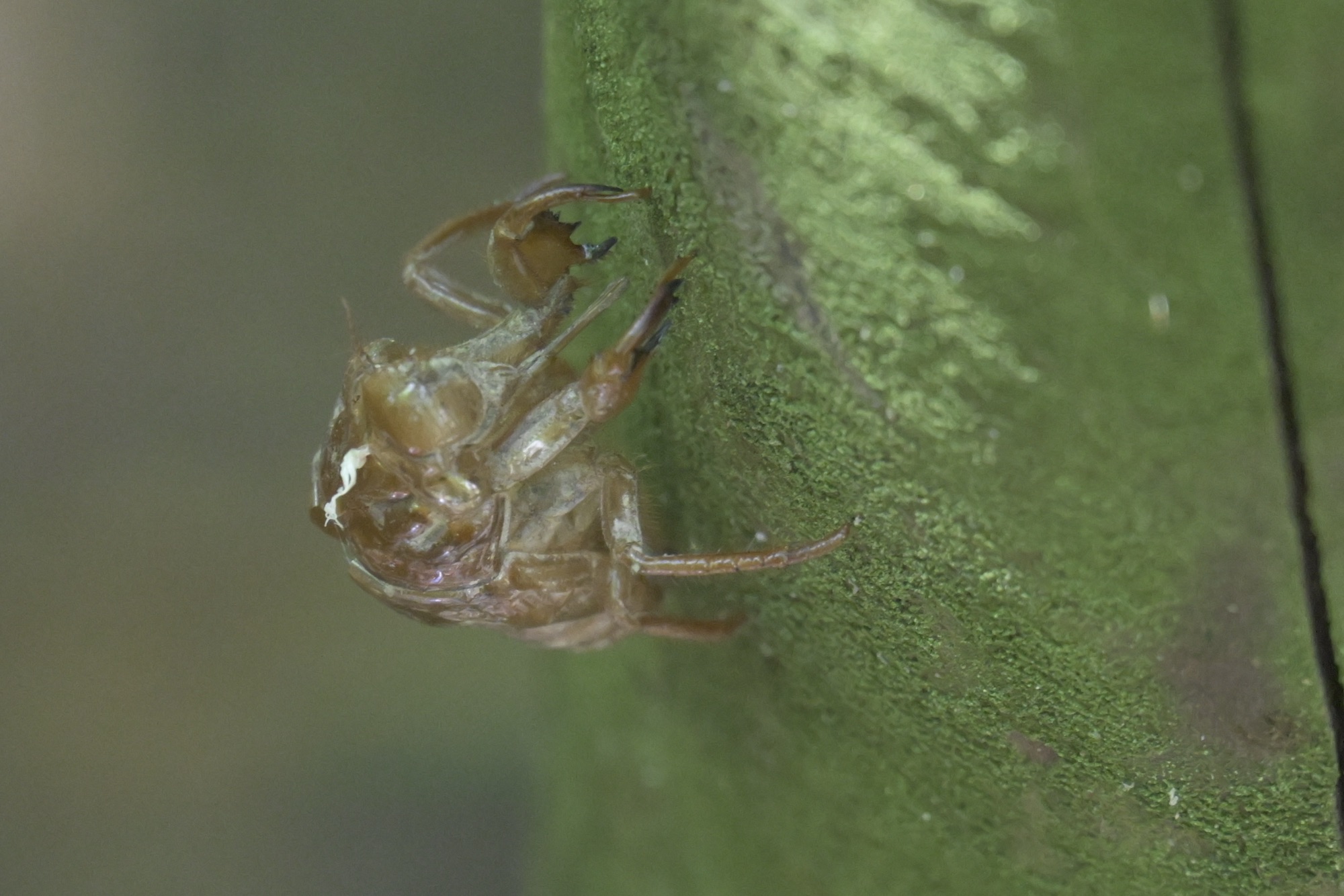
What is that in the photo? It is a Costa Rican cicada.
Today we received a reminder of one of the reasons we chose to take this cruise – the cold weather that always hits Iowa during Winter. My sister sent a couple photos looking at the street and driveway of our house and showing the snow on the ground. We heard the temperatures there were below zero (F) and the wind chill put the effective temperature at or below -20 (F). We can certainly check the “Cruise has warmer climates” box based on those photos.
We visited Puntarenas in 1999 during a cruise originating in Acapulco, Mexico. That cruise continued through the Panama Canal. When in Costa Rica in 1999 we took an excursion that included a boat ride on a river to view wildlife. I remember this is the first time I saw an iguana in the wild and also saw crocodiles at the mouth of the river. We booked an excursion this year to take us to Carara National Park with the hope to encounter animals there.
Before disembarking, from our balcony we watched dolphins swimming near the ship. As we made our way to the bus there was a welcome committee which included dancers in native dress, musicians and a couple people in costume as a sloth and a scarlet macaw. Our excursion group was under 30 people, so we took a van with 2 seats on the left and 1 on the right. It was cramped but not bad.
Our ride to the park took a little over 30 minutes. On the way we passed through the town of Puntarenas and traveled on a shore road that skirted several shipping terminals for cargo and oil. Our driver spotted a sloth in a tree on our left and stopped so we could get photos. Kelsey was able to get a photo as she and Jan were on the left side of the van. During our ride to the park our guide John Paul gave us an overview of the plans for the day and facts about life in Costa Rica. He was hoping we would see wildlife in the park – especially the scarlet macaw – and told us that we were guaranteed to see crocodiles at a river crossing.
We arrived at the park and immediately sighted a large scarlet macaw. I asked Kelsey and Jan to hurry out of the van so we could get a photo with this gigantic bird. You’ll find a photo of the macaw in today’s album.
John Paul took us to a sign that showed where we would be walking in the forest. He cautioned us to avoid touching the plants because several have venom that could cause extreme pain. There is a paved path we would walk – he suggested we stay on the path both to avoid damage to the environment and ourselves. He said the walk would take between 60 and 90 minutes depending on what we found.
After only a few minutes we came upon a good-sized gray iguana on a log about waist high. John Paul reminded us that the gray iguana is a carnivore so we should keep our distance (which we did). After admiring the iguana for several minutes, we continued our walk as John Paul explained the life of the trees in the coastal area.
The first thing he pointed out was a tree that is claimed to be the tallest in Costa Rica. We took a selfie with it in the background, and I took a separate photo showing more of the tree. John Paul said it was hundreds of years old but did not have an exact age for it. The next tree he showed us was one that is being strangled by a vine. Over years these vines surround the trunks of the tree and begin to suck the life out of the tree. I included a photo today of a tree with vines around the trunk.
Costa Rica has a dry season and a rainy season in the sea level climate. During the rainy season the area in which we were walking becomes flooded due to the heavy rains. This means the soil becomes less stable and trees with shallow and/or single roots are likely to fall. The trees in this area have developed a way to protect their life by sending multiple roots out from the trunk to give more stability as the ground becomes less stable. The same species of tree at a higher elevation does not have these additional roots because they are not exposed to the soggy soil. Here is a link to information about the rainforest.
During our entire walk in the forest there was a background sound familiar to us (during the Summer) – cicadas. In Costa Rica the cicadas are active the entire year in the rainforest. The insects here are smaller than those we are used to (as you might be able to tell from the featured photo).
The temperature today was in the low 90’s. Due to the heat animals we might normally see decided to stay at home in the shade. So, our wildlife experience at Carara National Park was limited to the gray iguana and the Costa Rican cicada. As we drove to our next stop, we did see several scarlet macaws in trees set back from the highway – and not easy to photograph with any acceptable results.
We drove to an area named “Cros Skywalk” which has a bridge over a river where crocs like to hang and a souvenir store and restaurant where humans like to hang. We began our visit there with Jan and I walking to the bridge to view crocs while Kelsey scoped out the store for treasures. We had to stay on one side of the busy bridge where people crowded the railing near the shore to gawk at the crocs sunning themselves. We moved past the masses to near the center of the bridge and had a much clearer view of the 5 crocs who graced us with their appearance today. You’ll find photos of these reptiles in today’s album.
After having all the fun we could absorb watching the crocs we headed to the store to see what Kelsey had found. As we left the bridge we ran into a couple from San Diego with whom we had shared several breakfasts/lunches – Cuca and Edgar. We spent a few minutes telling them about our croc viewing then continued to the store to find Kelsey.
Kelsey said they were running a special – buy 4 t-shirts, get 1 free. Jan and I purchased matching shirts with text to improve our grasp of Spanish by using the words “Pura Vida” (see the last photo from today). Kelsey found a shirt with a jungle leopard, and I found another generic Costa Rica shirt to complete the group of 4.
We had to wait to board the ship as there was only one gangplank and it was not wide. Groups were leaving for excursions as we were returning. It didn’t seem prudent to have only one point from which to exit or enter the ship, but they didn’t consult us before making that decision. Back in the room we plopped on our couch and took a selfie with our world map to complete another day in an interesting country.
We were supposed to leave port at 8:30 pm but did not do so. I looked out our balcony and saw flashing lights at the end of the pier. Eventually 2 ambulances made their way to the gangplank and after 10-15 minutes groups left the ship with 2 individuals in wheelchairs which were loaded into the waiting ambulances. With lights flashing, the ambulances drove down the pier into town and out of sight. Then the docking ropes were removed from the pier cleats, the thrusters were turned on, and we departed for 3 days at sea as we sailed to Puerto Vallarta, Mexico.
Photos of today’s activities can be found here.